
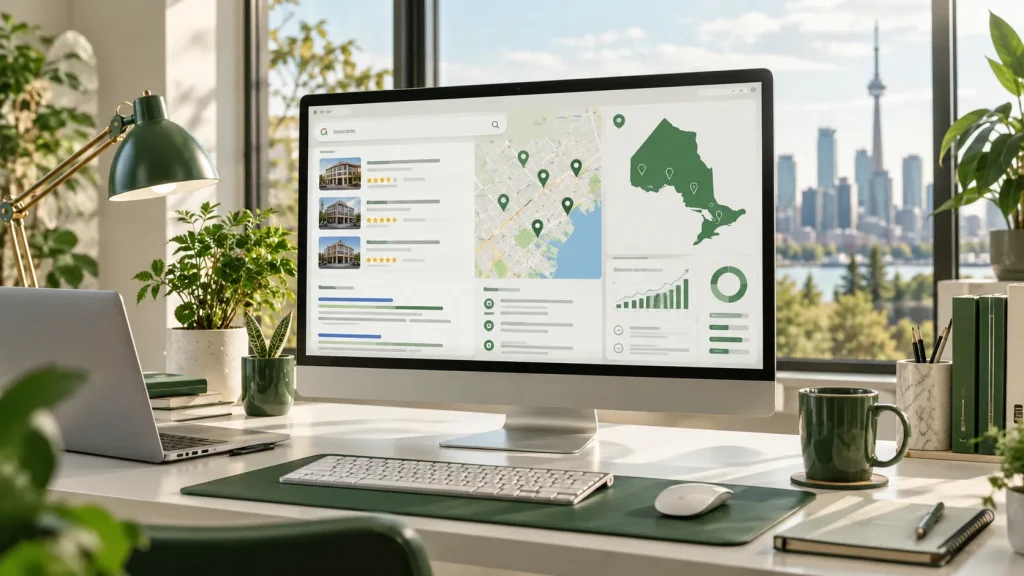
When people need a product or service nearby, they often turn to Google before they call a business, visit a store, or request a quote. Searches such as “plumber near me,” “cleaning company in Toronto,” “SEO agency in Ontario,” or “best dentist near Ottawa” can put local businesses directly in front of customers with immediate purchase intent.
That is where a local search engine optimization service becomes valuable.
Local SEO is the process of improving a business’s visibility in geographically relevant Google searches, Google Maps, local results, and organic search results. For businesses operating in Ontario and across Canada, effective local SEO can help connect a company with customers in the cities, neighbourhoods, and service areas it actually serves.
Google states that local search results are primarily influenced by relevance, distance, and prominence. Complete and accurate business information can help Google understand whether a business is relevant to a particular local search, while distance and prominence also influence which businesses appear.
But local SEO is much more than adding a city name to a webpage.
A strong local search strategy combines website optimization, Google Business Profile optimization, location-focused content, technical SEO, reviews, local authority, structured data, internal linking, and ongoing measurement.
This guide explains how it works, what a professional local search engine optimization service should include, how much the process can involve, and how Ontario businesses can build a stronger local search presence through a Technical SEO strategy.
What Is a Local Search Engine Optimization Service?

A local search engine optimization sethe objective should therefore not simply be “rank higher.”
Rvice is a specialized SEO service designed to improve a business’s visibility for searches connected to a specific geographic area.
Instead of focusing only on broad keywords, local SEO targets searches where location, proximity, or local intent matters.
Examples include:
- “Local SEO agency Ontario”
- “Cleaning services Toronto”
- “Commercial cleaning Kitchener”
- “Plumber near me”
- “Digital marketing agency Ottawa”
- “Landscaping company Mississauga”
- “Restaurant in downtown Toronto”
- “Accountant near Hamilton”
A local SEO campaign typically works across two major areas:
Google Maps and Local Search Visibility
This includes optimizing the business’s Google Business Profile and strengthening the signals that help Google understand the business, its services, and its geographic relevance.
Organic Local Search Visibility
This involves optimizing the business website so individual pages can appear for relevant location-based searches.
The strongest strategies connect both areas instead of treating Google Maps and the website as completely separate marketing channels.
Why Local SEO Matters for Businesses in Ontario
Ontario is a large and highly competitive market. A business competing for customers in Toronto faces a very different search landscape from one serving Ottawa, Hamilton, London, Kitchener-Waterloo, Mississauga, Brampton, Windsor, or smaller communities.
Customers also increasingly use highly specific searches.
Someone looking for a service may not search only for:
“Marketing agency”
They may search for:
“Digital marketing agency for small business Ontario”
Or:
“Local SEO agency near me”
That additional geographic intent changes the competitive landscape.
A properly implemented local search engine optimization service helps businesses build visibility around the locations and services that actually matter to their revenue.
Local SEO Can Support Several Customer Actions
Depending on the business, local search visibility can lead to:
- Phone calls
- Quote requests
- Appointment bookings
- Contact form submissions
- Store visits
- Direction requests
- Website visits
- Product enquiries
- Service consultations
- Online purchases
- Brand discovery
The objective should therefore not simply be “rank higher.” The objective is to make the business easier to discover, understand, trust, and contact when local customers are actively searching, supported by digital marketing strategies for small businesses.
How Google Local Search Ranking Works
Google explains that local results are primarily based on three broad factors:
Relevance
Relevance refers to how closely a business matches what the searcher is looking for.
For example, if someone searches for “commercial cleaning services,” Google needs enough reliable information to understand which businesses actually provide commercial cleaning.
This is why complete business information, clearly defined services, relevant website content, and accurate business categories matter.
Distance
Distance considers how close a business is to the searcher or the location specified in the search.
A search for:
“Coffee shop near me”
Can produce different results for people in different parts of Ontario.
Distance is therefore a factor a business cannot completely control through SEO. A company cannot realistically optimize its way into being physically closer to every searcher.
Instead, local SEO should accurately communicate where the business operates and make its relevant service areas clear.
Prominence
Prominence relates to how well-known or established a business appears to be.
Google notes that prominence can be influenced by information across the web, including links and directories, as well as review-related signals.
This is where long-term authority building becomes important.
A business with strong local recognition, useful content, relevant links, consistent business information, and an established review profile can provide stronger signals than a newly created website with little external recognition.
What Does a Professional Local Search Engine Optimization Service Include?

Local SEO should not be treated as one task.
A comprehensive campaign usually involves several interconnected components.
1. Local SEO Audit
The first step should be understanding the current situation.
A professional audit can examine:
- Google Business Profile setup
- Business categories
- Business information
- Website structure
- Local keyword targeting
- Location pages
- Service pages
- Title tags
- Meta descriptions
- Headings
- Internal links
- Technical SEO
- Indexation
- Structured data
- Local citations
- Online business information
- Reviews
- Local backlinks
- Competitor visibility
- Conversion opportunities
The purpose is not to generate a huge checklist.
The purpose is to identify which issues are most likely to limit local visibility and conversions.
2. Local Keyword Research
Keyword research helps identify how potential customers actually search.
For an Ontario business, keyword research might combine:
Service + Location
- SEO services Ontario
- Cleaning services Toronto
- Roofing contractor Ottawa
Service + City
- Local SEO Toronto
- Commercial cleaning Mississauga
- Accounting services Hamilton
Service + Neighbourhood
- Dentist North York
- Plumber Scarborough
- Lawyer downtown Ottawa
Service + Intent
- Best local SEO service
- Affordable SEO company Ontario
- Emergency plumber near me
- Commercial cleaning company near me
Problem-Based Searches
- How to improve Google Maps ranking
- Why my business isn’t showing on Google
- Local SEO for service area businesses
A good strategy does not force every keyword onto one page.
Instead, keywords should be mapped to the page that best satisfies the search intent.
3. Google Business Profile Optimization
Google Business Profile is a central part of local search visibility.
Google recommends verifying the business and keeping business information accurate and up to date.
A local SEO strategy can review and optimize areas such as:
- Primary business category
- Relevant secondary categories
- Business description
- Services
- Business hours
- Contact information
- Website URL
- Service areas
- Business attributes
- Photos
- Videos where appropriate
- Products where applicable
- Review management
- Customer questions and answers where available
However, simply filling out a profile does not guarantee a specific ranking position.
Google explicitly states that there is no way to request or pay for a better organic local ranking.
The goal is to create accurate, useful, consistent information rather than manipulate the profile.
4. Local Website Optimization
Your website remains an important part of your local search presence.
Google’s local ranking guidance notes that a business’s position in web results also contributes to local visibility, meaning traditional SEO practices remain relevant to local search.
A local SEO website strategy can optimize:
- Homepage
- Service pages
- Location pages
- Contact page
- About page
- Blog content
- Page titles
- Meta descriptions
- H1 and supporting headings
- Internal links
- Image alt text
- URLs
- Structured data
- Mobile usability
- Page speed
- Crawlability
- Indexability
The key is to make each page genuinely useful rather than creating dozens of nearly identical location pages.
5. Service-Area and Location Pages
Location pages can be useful when a business genuinely serves multiple areas.
For example, a business operating throughout Ontario might have relevant pages for:
- Toronto
- Mississauga
- Brampton
- Hamilton
- Kitchener
- Waterloo
- Ottawa
- London
- Windsor
But every page should have a reason to exist.
A strong location page can include:
- Services available in that area
- Local customer needs
- Service availability
- Relevant local information
- Localized faqs
- Unique supporting content
- Relevant testimonials where appropriate
- Clear contact options
- Links to related services
Simply replacing the city name on the same paragraph across 30 pages creates little additional value.
6. Local Citation Management
A citation is a mention of a business’s information on another website or directory.
Depending on the industry and market, citations may include:
- Business directories
- Industry-specific directories
- Local organizations
- Chambers of commerce
- Professional associations
- Relevant Canadian directories
- Local publications
Consistency matters.
Important business information should be accurate wherever it is legitimately published.
That can include:
- Business name
- Address
- Phone number
- Website
- Business category
Citation building should focus on quality and relevance rather than collecting hundreds of low-quality directory links.
7. Online Reviews and Reputation Signals
Reviews serve two purposes.
First, they help prospective customers evaluate a business.
Second, Google states that review count and positive ratings can contribute to local ranking.
A sustainable review strategy should focus on earning genuine feedback from real customers.
Businesses can build a process around:
- Completing the service.
- Asking the customer for feedback.
- Making the review process easy.
- Responding professionally.
- Monitoring recurring feedback.
- Improving the customer experience.
The goal should never be to manufacture reviews or manipulate ratings.
Authentic customer experiences are more valuable than artificially inflated numbers.
8. Local Content Marketing
Local content gives businesses another way to answer questions their customers are asking.
For example, an Ontario cleaning company could publish:
- Commercial cleaning checklist for Ontario offices
- How often should an office be professionally cleaned?
- Post-construction cleaning considerations
- Commercial cleaning costs in Ontario
- Office cleaning requirements for different business types
A local accounting firm could publish:
- Tax planning considerations for Ontario businesses
- Small business accounting questions
- Bookkeeping tips for Ontario entrepreneurs
- Common financial reporting mistakes
The best local content combines real expertise + genuine customer questions + geographic relevance, supported by a strategic content creation approach that helps businesses build useful, search-focused content.
9. Internal Linking for Local SEO
Internal links help users and search engines discover related pages.
For example:
Homepage ➜ Local SEO Service ➜ Ontario Location Page ➜ Service Page ➜ Contact Page
A local service article can also link naturally to relevant commercial pages.
For Oak Tree Marketing, the broader digital marketing agency website provides a natural destination for businesses researching broader digital growth services.
Its existing SEO offering also explains how technical SEO, content, keyword targeting, authority development, and analytics work together, while noting that SEO can be adapted for regional visibility through location-focused keywords, local landing pages, and optimized business listings.
Internal linking should be useful to the reader first.
10. Technical SEO for Local Businesses
Local SEO cannot compensate indefinitely for a technically unhealthy website.
Important technical areas include:
- Crawlability
- Indexability
- Canonical urls
- XML sitemap
- Robots.txt
- HTTPS
- Mobile usability
- Core Web Vitals
- Page speed
- Broken links
- Redirects
- Duplicate content
- Structured data
- JavaScript rendering
- Image optimization
For businesses with significant technical problems, fixing the foundation may be more valuable than publishing another batch of local blog posts.
Oak Tree Marketing also provides technical SEO services covering areas such as crawlability, indexing, site performance, structured data, and internal linking.
11. Local Schema Markup
Structured data can help search engines understand important information about a webpage and organization.
Depending on the business and page, relevant structured data may include:
- LocalBusiness
- Organization
- Service
- BreadcrumbList
- FAQPage where appropriate and eligible
- Product for relevant ecommerce pages
Schema should represent information that is actually present on the page.
It should not be used to add misleading information simply because a business wants search engines to see certain keywords.
12. Local Link Building and Authority Development
Links from relevant websites can help strengthen a site’s authority.
For local businesses, useful opportunities can include:
- Local news websites
- Industry associations
- Community organizations
- Sponsorship pages
- Business partnerships
- Local publications
- Professional organizations
- Relevant resource pages
Quality is more important than simply increasing the number of links.
A relevant link from a credible local or industry website can be more meaningful than a large collection of unrelated directory links.
Local SEO vs Traditional SEO: What’s the Difference?
Traditional SEO focuses broadly on improving organic search visibility.
Local SEO adds geographic intent to that process.
| Traditional SEO | Local SEO |
| Targets broader search demand | Targets geographically relevant searches |
| Focuses heavily on organic rankings | Focuses on organic + local search visibility |
| Content and authority are major components | Content, authority, GBP and local signals all matter |
| May target national audiences | Often targets cities, regions or service areas |
| Useful for online and national businesses | Particularly useful for businesses serving specific locations |
The two approaches are not competitors.
A local business can benefit from both.
For example, a Toronto-based service business may need traditional SEO to rank its service pages while also improving its Google Business Profile and local authority.
Who Needs a Local Search Engine Optimization Service?
Local SEO can be valuable for businesses where geography influences the customer’s buying decision.
Home Service Businesses
Examples include:
- Cleaning companies
- Plumbers
- Electricians
- HVAC contractors
- Roofers
- Landscapers
- Renovation companies
- Pest control companies
- Moving companies
Professional Services
Examples include:
- Accountants
- Lawyers
- Insurance agencies
- Consultants
- Marketing agencies
- Real estate professionals
- Financial service providers
Healthcare Businesses
Examples include:
- Dentists
- Physiotherapists
- Chiropractors
- Clinics
- Optometrists
- Wellness providers
Retail and Hospitality
Examples include:
- Restaurants
- Cafes
- Retail stores
- Salons
- Hotels
- Fitness studios
The exact local SEO strategy should depend on the business model, service area, competition, and customer journey.
Local SEO for Service-Area Businesses
Not every business serves customers at a physical storefront.
Many businesses travel to customers instead.
Examples include:
- Cleaning companies
- Mobile mechanics
- Contractors
- Repair businesses
- Home healthcare providers
- Landscaping companies
For these businesses, the strategy needs to clearly communicate where services are available without creating misleading location signals.
A service-area business should accurately represent its actual operating area and build useful location content around the places it genuinely serves.
Local SEO for Small Businesses in Ontario
Small businesses often have limited marketing budgets, so prioritization matters.
Instead of trying to optimize everything at once, a practical strategy can focus on the highest-impact fundamentals first.
Priority 1: Fix the Foundation
Start with:
- Website technical issues
- Indexing problems
- Incorrect business information
- Poor mobile experience
- Missing or weak service pages
Priority 2: Improve Local Relevance
Focus on:
- Google Business Profile
- Service descriptions
- Local keyword mapping
- Location pages
- On-page optimization
Priority 3: Build Trust
Develop:
- Genuine reviews
- Relevant citations
- Local partnerships
- Industry authority
- Helpful content
Priority 4: Measure and Improve
Monitor:
- Organic impressions
- Organic clicks
- Local rankings
- Google Maps visibility
- Website leads
- Phone calls
- Form submissions
- Conversion rates
This creates a more sustainable process than chasing rankings without understanding business outcomes.
How to Choose a Local Search Engine Optimization Service
Choosing an SEO provider should involve more than comparing monthly prices.
Ask potential providers how they approach:
Business and Competitor Research
Do they understand your market before recommending keywords?
Google Business Profile
Do they review the profile, categories, services, information accuracy, and local visibility?
Website SEO
Will they optimize the actual pages customers land on?
Content
Will they create genuinely useful content or produce large quantities of generic AI-generated pages?
Technical SEO
Do they identify crawl, indexing, performance, and structural problems?
Reporting
Will reports show meaningful business metrics rather than only keyword positions?
Transparency
Can you clearly understand what work is being performed and why?
A professional local search engine optimization service should be able to explain the strategy in plain language.
What Should a Local SEO Report Include?
A useful monthly or periodic report should connect SEO activity with measurable outcomes.
Depending on the campaign, reporting may include:
- Organic clicks
- Organic impressions
- Search queries
- Landing-page performance
- Local keyword visibility
- Google Business Profile performance
- Calls
- Website visits
- Form submissions
- Conversion data
- Review growth
- New referring domains
- Technical SEO progress
- Completed optimization tasks
- Upcoming priorities
The exact metrics should depend on the business.
A local plumber and a national ecommerce company should not receive identical SEO reporting.
How Long Does Local SEO Take to Work?

Local SEO is not an instant marketing channel.
Some improvements can become visible relatively quickly after technical issues or incorrect information are fixed. Other gains, particularly those involving authority, content, competition, and organic rankings, can take considerably longer.
The timeframe depends on factors such as:
- Existing website authority
- Business age
- Competition
- Location
- Search demand
- Website quality
- Current Google Business Profile strength
- Review profile
- Content quality
- Local authority
- Technical condition
- SEO consistency
A realistic strategy should therefore focus on measurable progress rather than promising a guaranteed ranking date.
Google itself does not provide a method for businesses to request or pay for a particular local ranking position.
Common Local SEO Mistakes to Avoid
Keyword Stuffing
Repeating the same city and keyword unnaturally does not create useful content.
Write for people first.
Creating Thin Location Pages
Publishing nearly identical pages for every city can create a poor user experience.
Each location page should provide genuine value.
Ignoring Google Business Profile
A well-optimized website does not mean the local profile should be neglected.
Buying Low-Quality Links
Large numbers of irrelevant links do not automatically create local authority.
Fake Reviews
Reviews should come from real customers and reflect genuine experiences.
Using Incorrect Business Information
Inconsistent or outdated business information can create confusion for both customers and search engines.
Focusing Only on Rankings
Ranking is useful, but the ultimate objective is business growth.
A position without calls, enquiries, appointments, or sales may not deliver the commercial value a business expects.
Local SEO and Conversion Optimization Should Work Together

Getting someone to your website is only the first step. Paid channels such as Google Ads campaigns can also complement organic visibility, while the page should make it easy for a potential customer to understand:
Once a potential customer arrives, the page should make it easy to understand:
- What you offer
- Where you operate
- Why customers should trust you
- How your service works
- What makes your company different
- How much information they need before contacting you
- What action they should take next
Strong local landing pages can include:
- Clear service descriptions
- Local relevance
- Customer-focused benefits
- Trust signals
- Reviews or testimonials where appropriate
- FAQs
- Service areas
- Strong calls to action
- Phone and contact options
- Simple enquiry forms
This is where SEO and conversion optimization overlap.
A Practical Local SEO Strategy for Ontario Businesses
A comprehensive campaign can follow this framework:
| Stage | Main Focus | Examples |
| 1. Research | Understand the market | Competitors, keywords, locations |
| 2. Audit | Find weaknesses | Website, GBP, citations, technical SEO |
| 3. Foundation | Fix critical issues | Indexing, structure, business information |
| 4. Relevance | Improve targeting | Service pages, location pages, keyword mapping |
| 5. Authority | Build trust | Reviews, citations, local links |
| 6. Content | Answer local searches | Guides, faqs, service content |
| 7. Conversion | Turn traffic into enquiries | CTAs, forms, calls, landing pages |
| 8. Measurement | Track performance | Traffic, visibility, leads, conversions |
| 9. Optimization | Improve continuously | Content updates, technical fixes, new opportunities |
This approach creates a system rather than a collection of disconnected SEO tasks.
Why Choose Oak Tree Marketing for Local SEO?
For businesses looking for a broader digital marketing partner, Oak Tree Marketing provides SEO and digital marketing solutions designed around business growth.
The agency works with small businesses, ecommerce brands, B2B companies, and startups, with services covering SEO, advertising, content, automation, and broader digital strategy.
Its SEO offering includes technical SEO, keyword targeting, content creation, link building, analytics, and ongoing optimization, with local SEO applications such as location-focused keywords, local landing pages, and optimized business listings.
For businesses that need multiple channels working together, this can be particularly useful because local visibility does not exist in isolation.
Local SEO can work alongside:
- Technical SEO
- Content marketing
- Google Ads
- Social media marketing
- Conversion optimization
- Digital marketing strategy
- Business growth consulting
For example, Oak Tree Marketing’s Google Ads service includes local and lead-generation campaigns designed around phone calls, form submissions, and in-person visits, showing how paid and organic local strategies can complement one another.
Frequently Asked Questions
What is a local search engine optimization service?
A local search engine optimization service helps businesses improve visibility for geographically relevant searches. It can include Google Business Profile optimization, local keyword research, website SEO, location pages, citations, reviews, local content, technical SEO, structured data, and authority building.
Is local SEO different from regular SEO?
Yes, although they overlap significantly. Traditional SEO focuses broadly on organic search visibility, while local SEO places additional emphasis on geographic relevance, Google Maps, Google Business Profile, local content, citations, reviews, and location-based searches.
Does local SEO help Google Maps rankings?
Local SEO can help improve the signals associated with local visibility, including business relevance and prominence. Google states that local results are primarily based on relevance, distance, and prominence.
However, no legitimate SEO provider can guarantee a specific Google Maps position.
How much does local SEO cost in Canada?
There is no single price that applies to every business.
The cost can depend on:
1. Number of locations
2. Competition
3. Service area
4. Current website condition
5. Number of services
6. Required content
7. Technical SEO requirements
8. Link and authority strategy
9. Google Business Profile management
10. Reporting requirements
A single-location business with a small service area may require a very different campaign from a company targeting multiple Ontario cities.
Can a small business benefit from local SEO?
Yes. Local SEO is particularly relevant when customers search for businesses based on location or proximity.
A small business can focus its budget on the services, locations, and customer searches most closely connected to revenue rather than attempting to compete nationally for broad keywords.
Should I target “near me” keywords?
You can research “near me” searches to understand customer intent, but you should not create awkward pages filled with repeated “near me” phrases.
Google already uses location information when determining local results, so the better approach is to clearly communicate the business’s services, locations, and relevance.
Do reviews help local SEO?
Google states that review count and positive ratings can influence local ranking.
More importantly, reviews help potential customers evaluate whether a business appears trustworthy and suitable for their needs.
Businesses should focus on obtaining authentic customer reviews rather than manipulating ratings.
How many location pages does my business need?
There is no universal number.
Create location pages when the business genuinely serves those locations and each page can provide useful, distinct information.
More pages do not automatically mean better local SEO.
Can local SEO generate leads?
It can contribute to lead generation by increasing visibility for searches made by people looking for relevant products or services.
However, traffic and rankings alone do not guarantee leads. Website experience, offer quality, competition, pricing, trust, conversion paths, and customer demand also matter.
Should I use local SEO and Google Ads together?
They can complement one another.
SEO works toward long-term organic visibility, while Google Ads can provide paid visibility for targeted searches. Oak Tree Marketing’s Google Ads offering, for example, includes local and lead-generation campaigns focused on actions such as calls and form submissions.
What should I look for in a local SEO agency?
Look for a provider that offers:
1. Clear research and strategy
2. Transparent reporting
3. Technical SEO expertise
4. Google Business Profile knowledge
5. Local keyword research
6. Quality content
7. Ethical link building
8. Conversion-focused optimization
9. Realistic expectations
10. Clear communication
Avoid providers that promise guaranteed rankings or rely entirely on one tactic.
Building Sustainable Local Search Visibility
A successful local search engine optimization service is not simply about adding city names to webpages or trying to manipulate Google Maps.
It is about making a business easier for search engines and customers to understand.
For an Ontario business, that means clearly communicating:
What you offer.
where you operate.
who you serve.
why customers should trust you.
how customers can contact you.
The strongest local SEO strategies combine accurate business information, Google Business Profile optimization, relevant website content, technical SEO, local authority, authentic reviews, useful location pages, internal linking, and continuous measurement.
Google’s own guidance emphasizes relevance, distance, and prominence as the primary factors behind local results.
That makes local SEO an ongoing process rather than a one-time website update.
If your business serves customers in Ontario or elsewhere in Canada and you want to build a stronger local search presence, start by identifying the services, locations, and searches that have the closest connection to your actual customers and revenue. Then build your SEO strategy around those opportunities.
Explore Oak Tree Marketing’s digital marketing solutions for growing businesses to see how SEO, paid advertising, content, and broader digital strategies can work together to support your business growth.