
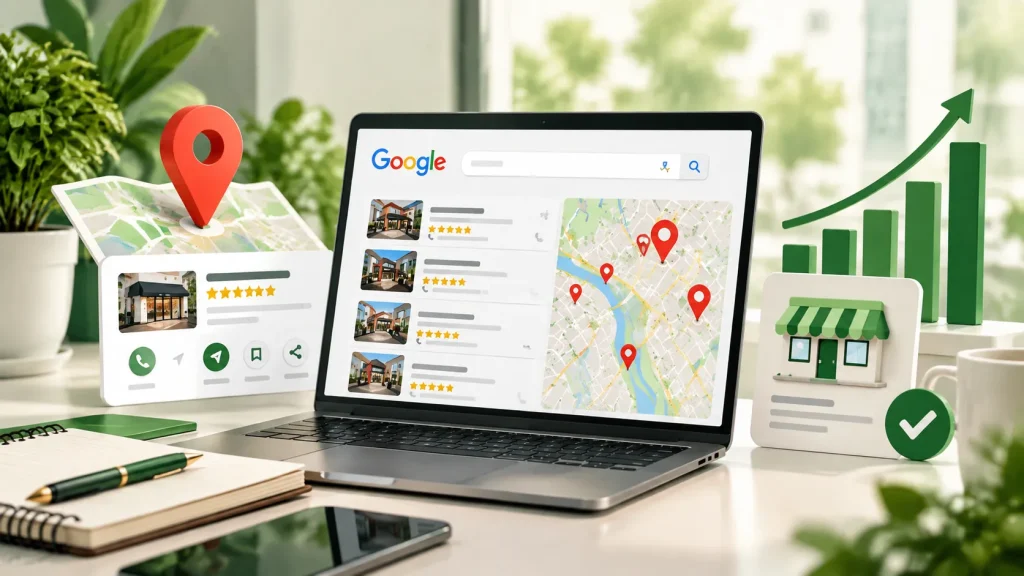
When customers search Google for a business near them, visibility can directly affect phone calls, website enquiries, bookings, quote requests, and visits. But appearing in local search is about much more than adding a city name to a webpage.
A local SEO consultant helps businesses improve their visibility in location-based Google searches by connecting the business’s website, Google Business Profile, local content, reviews, citations, technical SEO, and overall online presence.
For businesses serving Waterloo, Kitchener, London, Toronto, Ottawa, and other Ontario communities, local SEO can be especially valuable when customers are searching for a service and comparing nearbyproviders before making a decision.
Google says local search results are primarily influenced by relevance, distance, and prominence. Complete and accurate business information helps Google understand relevance, while distance depends on the searcher’s location and prominence reflects how well-known and established a business appears across relevant signals.
This guide explains what a local SEO consultant actually does, which services matter, how local SEO works, what businesses should measure, common mistakes to avoid, and how to evaluate a consultant before hiring one, including the role of technical SEO services in building a strong local search foundation.
What Is a Local SEO Consultant?
A local SEO consultant is an SEO professional who specializes in helping businesses become more visible when people search for products or services within a particular geographic area.
Instead of focusing only on broad keywords, local SEO connects services with locations and search intent.
For example, a general SEO campaign might target:
- Digital marketing agency
- Commercial cleaning services
- Dental services
- Accounting services
A local SEO strategy may target searches such as:
- Digital marketing agency Waterloo
- SEO consultant Kitchener
- Commercial cleaning services London Ontario
- Local SEO consultant Toronto
- SEO services Ottawa
- SEO consultant near me
The goal isn’t simply to generate more website traffic. A well-planned local SEO campaign aims to attract people who are geographically relevant and more likely to become customers.
A consultant may work on the website, Google Business Profile, local citations, reviews, location-focused content, internal linking, technical SEO, competitor research, and conversion paths.
What Does a Local SEO Consultant Do?
Local SEO is a multi-part process. A consultant typically begins by identifying where a business currently appears, what its customers search for, which competitors are visible, and what is preventing the business from receiving more qualified local visibility.
Local SEO Audit
The first step should usually be diagnosis rather than immediately building hundreds of directory listings or publishing generic city pages.
A local SEO audit can examine:
- Google Business Profile setup and optimization
- Primary and secondary categories
- Business information accuracy
- Website structure
- Local keyword targeting
- Service pages
- Location pages
- Internal links
- Local citations
- Name, Address, and Phone consistency
- Customer reviews
- Local competitors
- Organic search visibility
- Technical SEO
- Mobile usability
- Page speed
- Structured data
- Indexing and crawlability
- Conversion opportunities
The purpose is to identify the highest-impact problems and opportunities before creating a strategy. For businesses that need deeper website analysis, a dedicated technical SEO audit can also identify crawlability, indexing, site structure, speed, and structured-data issues.
Google Business Profile Optimization
Google Business Profile is one of the most important components of local search visibility.
Google recommends keeping business information complete and accurate, including business details, hours, categories, and other relevant attributes. Google also recommends managing reviews and adding photos and videos to help customers understand the business.
A local SEO consultant may review:
- Business category selection
- Business name accuracy
- Business description
- Services
- Attributes
- Opening hours
- Special hours
- Photos
- Videos
- Review responses
- Profile completeness
- Website connection
- Location information
- Service-area configuration where applicable
The objective is to make the profile accurately represent the real business rather than stuffing it with keywords.
Local Keyword Research
Local keyword research identifies what potential customers search for and how those searches relate to location, service, urgency, and buying intent.
A strong keyword strategy can include several categories.
Service + location
- Local SEO consultant Toronto
- SEO consultant Ottawa
- Digital marketing agency Kitchener
Service + city
- Local SEO services Waterloo
- SEO services London Ontario
- SEO agency Toronto
Problem-based searches
- How to improve Google Maps ranking
- Why is my business not showing on Google
- How to get more local customers from Google
Commercial searches
- Local SEO consultant near me
- Local SEO services for small business
- Hire local SEO consultant
High-intent searches
- Local SEO pricing
- Local SEO consultation
- Local SEO agency
- Local SEO expert
The important part is not maximizing keyword count. It is understanding which searches represent genuine customer demand and matching the right page to each search intent.
Local SEO vs. Traditional SEO
Local SEO and traditional SEO share many technical foundations, but their goals and signals can differ.
| Traditional SEO | Local SEO |
| Can target national or global audiences | Focuses on geographic markets |
| Often emphasizes organic rankings | Can target Maps, local results, and organic search |
| Broad topical authority is important | Local relevance and prominence are important |
| Content can target informational topics | Content often combines service and location intent |
| Backlinks remain important | Local and industry-relevant authority can matter |
| Website optimization is central | Website + Business Profile + local presence work together |
For many local businesses, treating local SEO as simply “regular SEO with city keywords” leaves important opportunities untouched. This is why a broader digital marketing strategy for small businesses can connect local search with SEO, advertising, content, and other customer-acquisition channels.
How Local SEO Works
Google explains local ranking primarily through relevance, distance, and prominence.
Relevance
Relevance is about how well a business matches what the searcher is looking for.
For example, if someone searches for “commercial cleaning services,” Google needs to determine which businesses actually provide that service.
Relevant signals can include:
- Business category
- Services
- Website content
- Business Profile information
- Location information
- Reviews
- Other online references
This is why a local SEO consultant needs to understand the actual services a business provides rather than simply adding keywords everywhere.
Distance
Distance refers to how far the business is from the searcher’s location or the location specified in the query.
This is one reason local rankings can vary significantly from one neighborhood to another.
A business may appear prominently for a search performed near its location but appear differently when the same search is performed from another part of a city.
Distance is therefore not something a consultant can simply “optimize away.” A good strategy works with geographic realities rather than promising identical rankings everywhere.
Prominence
Prominence refers to how well-known a business is.
Google explains that prominence can be influenced by information across the web, including links, articles, directories, and reviews. Google also notes that review count and positive ratings can contribute to local ranking.
This makes authority building an important part of local SEO.
Google Maps and the Local Pack
One of the most recognizable local search features is the Google local pack, where Google displays local businesses alongside map information.
Depending on the query, users may also encounter:
- Google Maps results
- Business Profiles
- Organic website results
- Review information
- Local business information
- Service information
A local SEO consultant should therefore avoid focusing exclusively on one ranking position.
A business may receive value from:
- Map visibility
- Organic rankings
- Brand searches
- Website traffic
- Phone calls
- Quote requests
- Booking enquiries
- Direction requests
The ultimate objective is useful visibility that supports business outcomes.
Local Website Optimization
Your website remains an important part of local SEO.
Google states that information used in local search can come from publicly available web content, including information from a business’s official website.
A local SEO consultant may optimize:
Homepage
The homepage should make it clear:
- Who the business serves
- What it offers
- Where it operates
- Why customers should consider it
- How customers can contact or purchase from it
Service Pages
Each important service should have a dedicated page when there is enough unique value to justify one.
A service page can address:
- What the service is
- Who needs it
- What is included
- Service benefits
- Process
- Locations served
- Frequently asked questions
- Trust signals
- Calls to action
Location Pages
Location pages can be useful when a business genuinely serves multiple locations.
However, creating dozens of nearly identical pages that only replace one city name with another is not a strong long-term strategy.
Each useful location page should provide genuine local value, such as:
- Local customer needs
- Services available in that area
- Relevant service-area information
- Unique examples or insights
- Local context
- Useful FAQs
- Clear conversion options
The purpose should be to help customers, not manufacture pages solely for search engines.
Internal Linking for Local SEO

Internal linking helps search engines discover and understand relationships between pages while also guiding visitors toward relevant information.
For example, an Ontario-focused digital marketing website could connect:
Homepage ➜ SEO service ➜ Local SEO content ➜ Location-specific service page ➜ Contact/consultation page
Oak Tree Marketing’s website already uses a service-oriented structure covering areas such as small business marketing, technical SEO, Google Ads, content creation, startup marketing, B2B marketing, and ecommerce marketing.
Relevant internal links can help users move from educational content into appropriate commercial services.
For example, businesses researching local visibility may also benefit from Oak Tree Marketing’s broader technical SEO, small business marketing, and content creation services where those services are relevant to their needs.
Local Citations and NAP Consistency
A local citation is an online mention of business information, commonly including:
- Name
- Address
- Phone number
This is often abbreviated as NAP.
Citations can appear on:
- Business directories
- Industry websites
- Local organizations
- Social profiles
- Review platforms
- Mapping services
- Chamber or association websites
- Local publications
The objective is not to create as many listings as possible.
Quality, accuracy, and relevance matter.
A citation audit can identify:
- Incorrect phone numbers
- Old addresses
- Duplicate listings
- Inconsistent business names
- Missing important directories
- Incorrect website URLs
- Duplicate profiles
Google also explains that local information can be compiled from multiple sources across the web, which makes accurate business information important beyond the Business Profile itself.
Reviews and Reputation Management
Reviews are important for two reasons: they can influence local visibility and they strongly affect how potential customers evaluate a business.
A local SEO strategy can include a process for:
- Asking genuine customers for feedback
- Making the review process easy
- Monitoring incoming reviews
- Responding appropriately
- Addressing legitimate complaints
- Identifying recurring customer concerns
The emphasis should always be on authentic customer experiences.
Businesses should not purchase fake reviews, manufacture testimonials, or manipulate customers into posting misleading feedback.
Google specifically recommends responding to reviews and notes that positive reviews and helpful responses can help a business stand out.
Local Content Strategy
Local SEO content should answer questions your customers actually have.
Instead of publishing dozens of shallow articles such as “Best Service in Toronto” with little useful information, build content around real customer problems.
Examples include:
- How Much Does Local SEO Cost in Ontario?
- How Long Does Local SEO Take to Work?
- Why Is My Business Not Showing on Google Maps?
- Google Business Profile Optimization Checklist
- Local SEO for Service Businesses
- Local SEO for Small Businesses
- How to Get More Local Leads From Google
- Local SEO vs. Google Ads
- How Reviews Affect Local Business Visibility
This type of content can support both informational searches and commercial decision-making.
Google’s Search Essentials emphasize creating helpful, reliable, people-first content rather than content created primarily to manipulate rankings.
Technical SEO for Local Businesses
Technical SEO is easy to overlook when a campaign focuses heavily on Google Business Profile.
But local businesses still need a technically sound website.
A consultant may check:
- Indexability
- Crawlability
- XML sitemap
- Robots.txt
- Canonical URLs
- Redirects
- Broken links
- Mobile usability
- Page speed
- Core Web Vitals
- HTTPS
- Duplicate content
- Structured data
- JavaScript rendering
- Internal linking
Google’s Search Essentials identify technical requirements, spam policies, and people-first content as core parts of creating websites eligible to appear in Search.
Local Business Structured Data
Structured data gives search engines machine-readable information about a webpage.
Google supports LocalBusiness structured data for communicating information such as business details and, where applicable, hours and other local business information.
Depending on the business and website structure, a technical SEO specialist may evaluate whether appropriate structured data is implemented correctly.
However, schema should support information that genuinely exists on the page. It should not be used to invent business information or make unsupported claims.
Local Competitor Analysis
A local SEO consultant should not build a strategy in isolation.
Competitor research can reveal:
- Which businesses dominate local results
- Which services competitors emphasize
- Which locations they target
- How strong their websites are
- Their Google Business Profile categories
- Review patterns
- Content gaps
- Backlink opportunities
- Local authority signals
- Conversion strategies
The objective isn’t to copy competitors.
Instead, competitor research helps identify the search landscape and opportunities to create a stronger, more useful presence.
Local Link Building
Links can contribute to website authority, but local link building should prioritize relevance and legitimacy over volume.
Potential opportunities may include:
- Local business organizations
- Chambers of commerce
- Industry associations
- Local sponsorships
- Community organizations
- Relevant local publications
- Business partnerships
- Professional associations
- Local events
- Useful resource pages
A consultant should be able to explain where links are coming from and why those sources are relevant.
Avoid strategies based on large quantities of low-quality links, automated link networks, or manipulative schemes.
What Should a Local SEO Consultant Measure?
A professional local SEO campaign should be measured using more than keyword rankings.
Useful metrics can include:
| Metric | What It Helps You Understand |
| Local search visibility | How often the business appears for relevant searches |
| Google Business Profile actions | How users interact with the profile |
| Website organic traffic | Search-driven visits |
| Qualified enquiries | Whether visibility produces potential customers |
| Phone calls | Direct lead generation |
| Form submissions | Website conversion activity |
| Booking requests | Commercial intent |
| Direction requests | Local visit intent |
| Review growth | Reputation development |
| Search impressions | Visibility across search queries |
| Click-through rate | How often users choose the result |
| Conversion rate | How effectively traffic becomes enquiries |
The exact KPI mix should depend on the business model.
A restaurant, law firm, ecommerce company, home-service business, and B2B company should not necessarily use identical reporting.
How Long Does Local SEO Take?
There is no universal timeline for local SEO.
Results depend on factors such as:
- Existing website authority
- Business history
- Competition
- Location
- Search demand
- Current Google Business Profile condition
- Website quality
- Review profile
- Local authority
- Technical issues
- Content quality
- Implementation speed
A consultant should therefore establish a baseline before promising outcomes.
Early improvements may involve fixing obvious technical or profile issues, while stronger organic and local visibility can require sustained work over a longer period.
Be cautious of anyone who guarantees a specific Google ranking or claims they can pay Google to place your business higher in local results. Google explicitly states that there is no way to request or pay for a better local ranking.
How Much Does a Local SEO Consultant Cost?
Local SEO pricing varies considerably.
The cost can depend on:
- Number of locations
- Geographic market
- Competition
- Number of services
- Website size
- Existing SEO condition
- Google Business Profile condition
- Content requirements
- Citation cleanup
- Technical SEO requirements
- Link-building requirements
- Reporting needs
- Ongoing optimization
Instead of choosing solely based on the lowest monthly price, compare what the engagement actually includes.
A useful proposal should explain:
- Initial audit
- Strategy
- Deliverables
- Implementation responsibilities
- Reporting
- Communication
- Expected workflow
- Measurement
- Contract terms
The consultant should also explain what they will not do.
That transparency can be just as valuable as the list of included services.
When Should You Hire a Local SEO Consultant?
A consultant may be worth considering if:
- Your business depends on customers from specific geographic areas
- Competitors consistently appear ahead of you
- Your Google Business Profile is incomplete
- Your website receives little local organic traffic
- Your business information is inconsistent online
- Your reviews are unmanaged
- You don’t know which local keywords matter
- Your location pages aren’t performing
- Your website has technical SEO problems
- You don’t have time to manage local SEO internally
- You are opening in a new market
- You want a structured long-term SEO strategy
You may not need ongoing consulting if your internal team already has the expertise and time to handle these responsibilities effectively.
In some situations, a one-time audit and strategy can be enough to give an experienced marketing team a clear roadmap.
Local SEO for Small Businesses in Ontario

Small businesses often face a difficult local search environment because they compete against established companies with stronger websites, larger review profiles, and longer histories.
A practical Ontario local SEO strategy can focus on a defined service area rather than trying to rank everywhere at once.
For example, a business may prioritize:
Waterloo
Focus on the specific services and customer segments that matter in the Waterloo market.
Kitchener
Build strong service relevance and make the website and Business Profile accurately reflect the customers and services being targeted.
London, Ontario
Develop useful local content and service pages where there is genuine demand and enough unique information to justify them.
Toronto
Toronto is a much larger and more competitive market, so a strategy may require tighter service targeting, stronger authority development, and more detailed competitor research.
Ottawa
Businesses serving Ottawa may need to distinguish between broad city-level searches and more specific service or neighborhood intent.
The key principle is the same across Ontario: build local relevance around the markets you genuinely serve rather than creating artificial location signals.
Local SEO Consultant vs. Local SEO Agency

A consultant and an agency can both provide local SEO expertise, but the delivery model may differ.
A local SEO consultant may provide:
- Strategy
- Audits
- Keyword research
- Consulting
- Recommendations
- Training
- Implementation guidance
A local SEO agency may provide a broader execution team covering:
- SEO strategy
- Technical SEO
- Content
- Google Business Profile
- Local citations
- Link building
- Reporting
- Conversion optimization
- Other digital marketing channels
Neither model is automatically right for every business.
The better fit depends on whether you need strategic guidance, hands-on execution, or both.
How to Choose a Local SEO Consultant
Before hiring someone, ask specific questions.
What Will You Audit First?
A consultant should be able to explain how they will diagnose the existing situation before recommending a large list of services.
How Do You Measure Success?
Look for reporting that connects SEO activity with meaningful business outcomes rather than relying exclusively on ranking screenshots.
How Do You Handle Google Business Profile?
Ask how they approach categories, services, reviews, photos, business information, and ongoing management.
How Do You Build Local Authority?
Ask what types of citations, partnerships, links, or local mentions they pursue and why.
Will You Create Location Pages?
If yes, ask how they make those pages genuinely useful and different from one another.
Do You Guarantee Rankings?
A responsible provider should recognize that Google rankings vary by query, competition, geography, and algorithmic systems.
Who Owns the Accounts?
Your business should retain appropriate ownership and access to important assets such as your website, Google Business Profile, analytics, and Search Console.
What Happens If We Stop Working Together?
You should understand what happens to your website changes, listings, content, accounts, reporting, and other assets if the engagement ends.
Red Flags to Watch For
Be careful when a local SEO provider:
- Guarantees the #1 position on Google
- Promises instant rankings
- Claims to have a secret relationship with Google
- Wants to create hundreds of low-quality pages
- Uses keyword stuffing
- Buys fake reviews
- Builds large quantities of irrelevant backlinks
- Refuses to explain the work being performed
- Won’t provide meaningful reporting
- Controls all of your digital assets without proper access
- Focuses exclusively on vanity metrics
- Copies competitor content
- Creates duplicate location pages at scale
Google’s own guidance makes clear that local ranking cannot simply be purchased or requested, so realistic expectations are an important part of choosing a provider.
A Practical Local SEO Strategy for 90 Days
A focused 90-day campaign can be organized into three stages.
Month 1: Audit and Foundation
Start by establishing the baseline.
Tasks may include:
- Local SEO audit
- Competitor research
- Keyword research
- Google Business Profile audit
- Citation audit
- NAP consistency review
- Technical SEO audit
- Website structure review
- Service-page analysis
- Internal-link analysis
- Conversion tracking review
The goal is to identify the highest-priority opportunities.
Month 2: Optimization and Content
Next, implement the strategy.
Potential work includes:
- Google Business Profile improvements
- Service-page optimization
- Local landing pages where justified
- Internal linking
- Local content
- Citation cleanup
- Review process
- Technical fixes
- Structured data improvements
- Conversion improvements
Month 3: Authority and Refinement
Once the foundation is stronger, focus on ongoing growth.
This can include:
- Local link opportunities
- Competitor monitoring
- Review growth
- Content expansion
- Search-query analysis
- Conversion optimization
- Google Business Profile monitoring
- Ranking and visibility analysis
- Technical maintenance
The strategy should then continue based on measured results rather than following a rigid checklist forever.
Why Local SEO Should Connect With Your Wider Marketing Strategy
Local search should not operate in isolation.
A business may use:
- Local SEO
- Technical SEO
- Content marketing
- Google Ads
- Social media marketing
- Email marketing
- Conversion optimization
- Branding
- Marketing automation
These channels can support one another.
For example, strong organic content can support search visibility, while Google Ads management can capture demand while SEO develops. Technical SEO can improve the website foundation, while better conversion paths can help turn local traffic into enquiries.
Oak Tree Marketing provides broader digital marketing services for small businesses, startups, B2B companies, ecommerce brands, and other growing businesses.
Businesses that need support beyond local search can also explore Oak Tree Marketing’s technical SEO, Google Ads, and content creation capabilities as part of a broader digital strategy.
Why Work With Oak Tree Marketing for Local SEO?
Oak Tree Marketing is a Canadian digital marketing agency focused on helping growing businesses build practical, measurable digital marketing strategies.
Rather than treating local SEO as a collection of isolated tasks, the strategy can be connected with the wider website, content, technical SEO, advertising, and conversion ecosystem.
For businesses serving Ontario markets such as Waterloo, Kitchener, London, Toronto, and Ottawa, a localized strategy can be developed around the areas and customers that genuinely matter to the business.
The broader Oak Tree Marketing approach includes data-driven digital marketing, SEO, advertising, automation, content, and other growth solutions.
If your business needs more than local visibility alone, combining local SEO with the right supporting digital channels can create a more complete customer acquisition strategy.
Frequently Asked Questions About Local SEO Consultants
What is a local SEO consultant?
A local SEO consultant is a specialist who helps businesses improve their visibility in geographically relevant Google searches. Their work can include Google Business Profile optimization, keyword research, local website optimization, citations, reviews, content, technical SEO, competitor analysis, and performance tracking.
What does a local SEO consultant do for a small business?
They identify where the business is losing local visibility and create a strategy to improve relevance, authority, website performance, and customer conversion opportunities.
Is local SEO different from regular SEO?
Yes. Local SEO includes many traditional SEO practices but adds a strong geographic component, including Google Business Profile optimization, local search intent, citations, reviews, and location-focused content.
Can a local SEO consultant guarantee Google rankings?
No legitimate consultant can guarantee a specific Google ranking. Google states that local rankings are primarily based on relevance, distance, and prominence and that businesses cannot pay to request a better local ranking.
How important is Google Business Profile for local SEO?
It is an important part of local search visibility because it allows businesses to provide information that can appear in Google Search and Maps. Google recommends keeping the profile complete and accurate and managing reviews and other business information.
Do I need a website for local SEO?
A strong Google Business Profile is important, but a well-optimized website can provide additional context about your services, locations, expertise, and business. Google also uses publicly available website information when compiling local business information.
How many citations does my business need?
There is no universal number. The priority should be accurate, relevant, trustworthy listings rather than creating large numbers of low-quality citations.
Should every city have its own SEO page?
Not necessarily. A location page should exist because it provides useful, unique information for customers in that location not simply because another city keyword exists.
Is local SEO worth it for a service-area business?
It can be valuable when customers search for the services you provide within defined geographic areas. The strategy should reflect your actual service area and comply with Google Business Profile requirements.
Can local SEO work with Google Ads?
Yes. SEO and paid search serve different functions and can complement one another. Google Ads can provide paid visibility while organic and local SEO work toward longer-term search visibility.
Final Thoughts: Finding the Right Local SEO Consultant
A local SEO consultant should do more than add location keywords to a website.
Effective local SEO requires a connected understanding of Google Business Profile optimization, local search intent, website SEO, technical foundations, reviews, citations, content, local authority, competitor behavior, and conversions.
Google’s published guidance makes three concepts especially important when thinking about local visibility: relevance, distance, and prominence.
For businesses in Ontario, including those serving Waterloo, Kitchener, London, Toronto, Ottawa, and surrounding communities, the strongest strategy is usually the one that starts with the actual business, its customers, its services, and its geographic market.
If you are looking for a local SEO consultant for your business, start with an audit, establish measurable goals, understand the work being proposed, and choose a strategy built around sustainable visibility rather than ranking promises.
For businesses that need a broader growth strategy alongside local SEO, you can explore Oak Tree Marketing’s digital marketing services and determine which combination of SEO, content, paid advertising, technical optimization, and other services fits your business goals.