By Oak Tree Marketing | Canada’s Digital Marketing Agency for Growing Businesses
You’ve been told SEO is important. You’ve seen the ads, the promises, the agencies claiming they’ll get you to “page one guaranteed.” But when you actually sit down to figure out what an organic SEO company does and whether it’s worth your money the answers you find online are surprisingly thin.
Most articles covering this topic are written by the agencies themselves, which means they’re selling, not explaining. They list services like bullet points on a resume and tell you organic SEO is “a long-term investment” without ever telling you what that looks like in dollar terms, timelines, or results.
This guide is different. It’s written for Canadian business owners, marketing managers, and founders who want to understand organic SEO deeply enough to make a real hiring decision, not just fill out a contact form and hope for the best.
By the time you finish reading, you’ll know exactly what an organic SEO company does, how to evaluate one honestly, what to pay, what to expect, and the questions that separate real agencies from ones who’ll waste your budget for six months before you notice.
What Is an Organic SEO Company Actually?
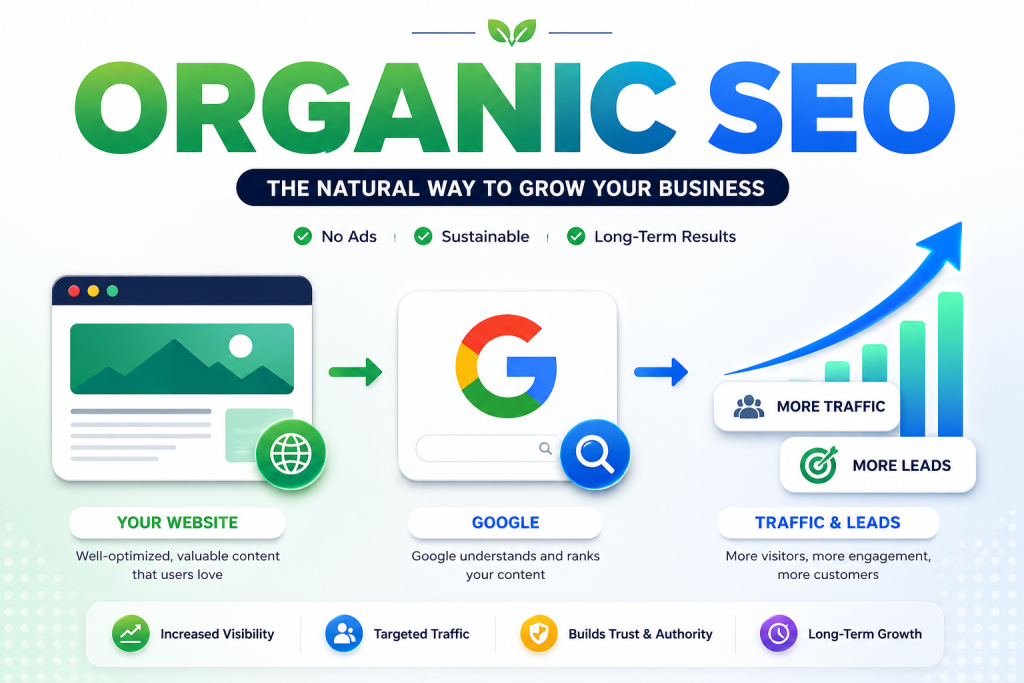
An organic SEO company helps your website show up in search results without paying for ads. The word “organic” refers to the non-paid section of Google, Bing, or any other search engine the listings that appear because the algorithm genuinely considers them the best answer to a search query, not because someone bought a placement.
The contrast matters. When you run Google Ads, you’re renting visibility. The moment you stop paying, the traffic stops. Organic SEO builds something more durable: a site architecture, content library, and backlink profile that earns search visibility over time. Done correctly, the traffic compounds. A well-optimized page you published two years ago can still be bringing in leads today.
That’s the pitch, anyway. And it’s accurate but only when the work is done with skill, patience, and genuine strategic thinking. Which is exactly why choosing the right organic SEO agency matters so much.
At its core, an organic SEO company does three things:
Google’s AI features can surface synthesized answers alongside traditional search results, changing how users discover information and how websites earn visibility. Google provides guidance for site owners on how their content can appear in AI-powered search experiences. Google Search Central AI Features and Your Website This is the unglamorous foundation: site speed, mobile responsiveness, URL structure, Core Web Vitals, schema markup, canonical tags, internal linking architecture. Most business owners never see this work. It happens in the code. But without it, everything else underperforms.
Content development Creating or improving the pages, blog posts, service descriptions, and guides that give search engines something meaningful to rank. Content is where keyword strategy meets actual writing. Great content answers real questions with real depth. It’s not keyword stuffing. It’s writing that earns both Google’s trust and your reader’s attention simultaneously.
Authority building Earning links from other websites that point back to yours. Links are votes. The more credible, relevant sites that link to you, the more authority you carry in Google’s eyes. This is the work sometimes called “off-page SEO,” and it’s where the most significant long-term ranking gains come from and where the most significant risks from bad agencies live.
Everything an organic SEO agency does falls under one of these three pillars. The question isn’t whether to do them, it’s how well, how consistently, and how strategically.
Organic SEO vs. Paid SEO: Why the Distinction Matters Now More Than Ever
“Paid SEO” is technically a misnomer; what people usually mean is PPC (pay-per-click advertising), specifically Google Ads. But the comparison is worth making explicitly because it shapes budget decisions for every business that discovers SEO.
Here’s the honest breakdown:
Google Ads (PPC):
- Immediate visibility once campaigns are live
- Traffic stops the moment your budget runs out
- Costs scale with competition high-value keywords in competitive markets (legal, finance, healthcare) can cost 15-80+ per click in Canada
- Great for short-term lead generation, product launches, seasonal campaigns, and testing which offers convert
- No cumulative asset you’re not building anything that persists
Organic SEO:
- Typically 4-12 months before meaningful ranking improvements in competitive markets
- Traffic grows and compounds over time rather than disappearing overnight
- Higher trust signal research consistently shows users click organic results at higher rates than ads for informational and research-phase queries
- Builds a long-term content and authority asset that continues working even if you pause investment
- Requires sustained effort SEO is not a one-time project
The right question isn’t “SEO or ads?” it’s “when does each make sense?” Early-stage businesses with immediate revenue pressure often need paid ads to survive while SEO builds in the background. Established businesses with a longer horizon often find organic SEO delivers significantly better cost-per-acquisition over a 12-24 month window.
One more nuance that most comparisons miss: organic SEO and paid search amplify each other. When you appear in both the ad and the organic positions for the same keyword, click-through rates for both increase. Users see you twice and the brand impression compounds. This is why the best digital marketing agencies including Oak Tree Marketing approach these channels as complementary rather than competing.
What Does an Organic SEO Agency Do? The Real Services Behind the Buzzwords
Every organic SEO agency will list the same service names. Here’s what they actually mean in practice:
Keyword Research
Not just “finding keywords” real keyword research means understanding search intent. Why is someone searching for this phrase? Are they researching, comparing, ready to buy, or trying to solve a specific problem? Each intent type requires a different type of content response.
Good keyword research involves identifying which queries have realistic ranking potential for your site (based on your current authority), which ones have commercial value (likely to lead to a conversion, not just a visit), and how they cluster together into topics rather than isolated terms.
Poor keyword research, the kind many discount SEO providers deliver, chases high-volume terms without regard for intent, competition, or whether ranking is realistically achievable. You end up with traffic that doesn’t convert or rankings you can’t actually reach.
On-Page Optimization
Adjusting individual page elements so search engines understand what each page is about and why it should rank. This includes:
- Title tags and meta descriptions (what appears in search results)
- H1 and heading structure (the hierarchy of information on the page)
- Internal linking (connecting related pages so authority flows through your site)
- Content depth and quality (does the page actually answer the search query better than competitors?)
- Image alt text, structured data, and semantic markup
- URL structure and canonical configuration
On-page work is ongoing, not a one-time fix. As your content library grows and search intent evolves, pages need to be revisited, updated, and refined.
Technical SEO
This is the infrastructure layer, the work that makes everything else possible. Common technical SEO tasks include:
- Site speed optimization Google uses Core Web Vitals (Largest Contentful Paint, Interaction to Next Paint, Cumulative Layout Shift) as direct ranking signals. Slow sites rank lower.
- Mobile optimization Google indexes the mobile version of your site first. A site that isn’t genuinely mobile-friendly loses significant ranking potential.
- Crawl budget management Making sure Google’s crawlers spend their time on your important pages, not on duplicate content, thin pages, or broken URLs.
- Schema markup Structured data that helps search engines understand your content type (FAQ, product, review, local business, article) and can earn rich results in the SERP.
- XML sitemaps and robots.txt Directing search engines to what they should and shouldn’t crawl.
- Redirect management Ensuring site changes, migrations, and URL updates don’t lose accumulated authority.
If you’re wondering why your new content isn’t ranking despite being genuinely good, technical issues are often the culprit. No amount of great writing overcomes a site that search engines can’t properly crawl and index.
At Oak Tree Marketing, our Technical SEO Agency service starts with a comprehensive audit that uncovers the specific technical barriers holding your site back before any content work begins. You can’t build on a cracked foundation.
Content Creation and Content Strategy
Content is what search engines rank. It’s also what your audience reads, trusts, shares, and acts on. These two goals align more than most people realize: genuinely helpful content that serves human readers tends to perform well in search too, because Google has become remarkably good at detecting quality.
A serious organic SEO agency does more than produce blog posts on a schedule. They develop a content strategy that:
- Maps content to the full buyer journey (awareness → consideration → decision)
- Identifies topic clusters that build topical authority in your niche
- Prioritizes content based on ranking potential, business value, and competitive difficulty
- Creates content that earns backlinks naturally by being genuinely more useful than anything else ranking for the target query
- Continuously updates and improves existing content as it ages, to maintain rankings
Oak Tree Marketing’s Content Creation Agency service approaches this as an integrated system, not a publishing conveyor belt. Strategy first, production second, optimization always ongoing.
Link Building and Digital PR
Backlinks remain one of the three most important ranking signals in Google’s algorithm. But quality matters enormously. Ten links from genuinely authoritative, relevant websites in your industry are worth more than five hundred links from content farms, link directories, or private blog networks (PBNs).
Legitimate link building methods include:
- Digital PR Creating genuinely newsworthy content (original research, data studies, tools, visual assets) that earns coverage and links from journalists and industry publications
- Outreach-based link building Identifying relevant sites and building relationships that lead to link placements, guest contributions, or mentions
- HARO and journalist sourcing Positioning your team as expert sources for media coverage
- Broken link building Identifying dead links on relevant sites and offering your content as a replacement
- Competitor link analysis Finding where competitors earn links and targeting the same sources
What’s off the table: buying links in bulk, using PBN networks, reciprocal link schemes, or any tactic that Google’s guidelines define as manipulative. These work short-term and collapse painfully when algorithm updates hit and they always do.
Local SEO
For Canadian businesses serving specific geographic markets, local SEO is a distinct discipline that deserves dedicated attention. It involves optimizing your Google Business Profile, building consistent citations across local directories, earning reviews from local customers, creating location-specific content, and optimizing for “near me” and location-qualified search queries.
Our Digital Marketing Agency for Small Business service includes local SEO as a core component, because local visibility is often the difference between a thriving neighborhood business and one that’s invisible to people searching for exactly what it offers.
Reporting and Analytics
This is where many agencies fall short. Traffic is a vanity metric if it doesn’t connect to revenue. Good organic SEO reporting shows:
- Keyword ranking changes (with context did rankings improve for terms that drive actual leads?)
- Organic traffic growth (segmented by landing page, so you know which content is working)
- Conversions from organic traffic (form fills, phone calls, purchases, whatever your business goal is)
- Technical health indicators (crawl errors, index coverage, Core Web Vitals)
- Backlink profile growth (new referring domains earned, domain authority trends)
Monthly reporting should tell a clear story about whether the work is moving toward your business goals, not just produce a stack of charts that look impressive but don’t answer the question “Is this worth what we’re paying?”
The 2026 Shift: AI Search, GEO, and Why Traditional Organic SEO Isn’t Enough Anymore
Here’s what most organic SEO company articles won’t tell you: the SEO landscape shifted significantly in 2024-2026, and the change is structural, not cyclical.
Google’s AI Overviews (formerly Search Generative Experience) now appear at the top of results for a wide range of queries, generating synthesized answers before users even see the traditional blue links. On many informational searches, users get their answer without clicking through to any website. This is called a “zero-click search,” and its prevalence has increased dramatically.
Simultaneously, a meaningful portion of search behavior has migrated to AI assistants ChatGPT, Perplexity, Claude, Gemini where users ask questions and receive answers sourced from the web without ever visiting a traditional search engine.
This creates two new challenges for organic SEO:
Challenge 1: Traditional organic rankings may deliver less traffic even when you rank well. If an AI Overview appears for a query you rank #1 for, your click-through rate drops sometimes by 30-50% compared to pre-AI Overview benchmarks. Ranking isn’t enough if the SERP format has changed.
Challenge 2: If AI assistants aren’t recommending your business, you’re invisible to an increasingly large segment of your target audience.
The discipline that’s emerging to address this is called Generative Engine Optimization (GEO) or Answer Engine Optimization (AEO) optimizing your content and authority signals so that AI-powered search tools surface and recommend your business.
GEO/AEO best practices overlap significantly with strong organic SEO fundamentals:
- Creating genuinely authoritative, well-cited content that AI systems trust as a source
- Using structured data (schema markup) that helps AI parse your content accurately
- Building brand entity signals (consistent mentions across reputable sources) that AI tools recognize as indicators of credibility
- Optimizing for conversational, question-based queries rather than just short keyword phrases
- Earning citations in industry publications, directories, and databases that AI systems commonly reference
When you’re evaluating an organic SEO agency in 2026, ask specifically how they approach GEO and AI search visibility. An agency that only knows traditional organic SEO, even very good traditional organic SEO is working with an incomplete map.
At Oak Tree Marketing, our approach integrates AI search optimization alongside traditional organic SEO, because your customers are finding answers in more places than just the first page of Google results.
How to Choose the Right Organic SEO Company: An 8-Point Vetting Framework
Most “how to choose an SEO agency” sections are thin and generic. This one isn’t.
Point 1: Check Their Own Organic Performance
This sounds obvious, but most people skip it. Google the agency by name. Look at their own website rankings for relevant terms. Use a free tool like Ahrefs’ free backlink checker or Semrush’s free version to look at their organic traffic estimates.
An organic SEO company that can’t rank its own site is making a significant credibility claim without supporting evidence. You want to see that they practice what they sell. Not every agency will rank for ultra-competitive terms like “SEO agency Canada” but they should rank for something meaningful. A completely invisible organic footprint is a warning sign.
Point 2: Demand Relevant Case Studies with Verifiable Results
Not just testimonials actual case studies with before/after traffic data, ranking screenshots, or conversion improvements tied to specific SEO work. And “relevant” is the operative word: a case study from a law firm doesn’t tell you much if you run an e-commerce store.
Ask: “Can you show me a case study from a business in my industry or with a similar challenge?” If they can’t produce one, that’s meaningful information.
Ask them to walk you through the specific work that drove the results, not just the outcome, but the strategy, the specific content created, the links earned, and the timeline. An agency that can narrate the process in detail is an agency that actually did the work.
Point 3: Understand Exactly How They Build Links
This is the question that separates legitimate agencies from ones who’ll eventually get your site penalized. Ask:
- What link building methods do you use?
- Can you show me examples of recent links you’ve earned for clients?
- Do you use any form of PBN, link buying, or mass directory submission?
- How do you vet the quality of sites you pursue links from?
A trustworthy agency will answer these questions in specific, concrete terms. They’ll describe their outreach process, the types of publications they target, and their quality standards. Vague answers “we use white-hat methods” without elaboration should prompt more questions.
Point 4: Evaluate Their Content Process
Ask: “How do you decide what content to create?” Good answers involve keyword research tied to search intent, competitive analysis, topical authority mapping, and alignment with your sales funnel. Bad answers involve “we post X blog posts per month” as if frequency is the strategy.
Also ask who writes the content. Is it in-house writers with subject matter expertise? Is it AI-generated and lightly edited? Is there a review process for accuracy and quality? Content that reads well but contains factual errors or generic advice doesn’t build E-E-A-T (Experience, Expertise, Authoritativeness, Trustworthiness) and Google increasingly rewards E-E-A-T as a ranking signal, especially in competitive niches.
Point 5: Assess Their Reporting and Communication
Ask to see a sample monthly report. Evaluate: Does it show business outcomes (conversions, leads, revenue from organic) or just metrics (sessions, rankings)? Is it formatted so you can actually understand the story it’s telling, or does it require an SEO dictionary to interpret?
Also ask: Who is your point of contact? How often do you communicate? How quickly do you respond to questions or urgent issues? Poor communication is one of the most common complaints clients have about SEO agencies. You pay a monthly retainer and then struggle to get a reply.
Point 6: Understand Their Process for Your Specific Site
Generic SEO processes don’t always fit specific situations. A new website needs a different approach than a 10-year-old site that’s been penalized. An e-commerce store needs different technical SEO than a B2B SaaS company. A local service business needs a different content strategy than a national brand.
Ask: “What’s your typical process for a site like mine?” and listen for specificity. An agency that immediately tailors its answer to your situation “given that you’re an e-commerce store on Shopify with X pages, we’d start with…” is demonstrating that they’re actually thinking about your case, not reciting a pitch.
Point 7: Ask About AI Search and GEO
As discussed above, this is now a non-negotiable part of a complete organic SEO strategy. Ask: “How do you approach optimization for AI search tools like Google AI Overviews, ChatGPT, and Perplexity?” An agency that responds with a blank stare or tells you “that’s not really relevant” is working from a 2022 playbook.
Point 8: Check Their Contract and Exit Terms
Serious question: what happens if you want to stop working with them? Can you take your content, your Google Analytics access, your Google Search Console data, and your backlink history with you? Or is any of it proprietary to the agency in some way?
A trustworthy agency retains your access to all assets. Your website is yours. Your data is yours. Your content is yours. Be very cautious about agencies that set up analytics in their own account rather than yours, or that retain ownership of content created during the engagement. That’s a lock-in tactic, not a partnership.
What Should You Pay? Honest Pricing Guidance for Canadian Businesses
Pricing is the topic most organic SEO company guides deliberately avoid. Here’s the honest version.
The range is wide from $300/month to $30,000+/month and the variance is mostly explained by three factors: the competitiveness of your market, the scope of work, and the level of strategic expertise involved. Price alone doesn’t predict quality. Cheap SEO is often expensive in the long run (penalty recovery costs money). Expensive SEO isn’t automatically better.
Here’s a realistic framework for the Canadian market in 2026:
Entry-level organic SEO (400-1,200/month CAD)
What you realistically get: monthly reporting, basic on-page optimization recommendations, perhaps some content suggestions, and minimal link building. This tier often involves junior team members or offshore execution. Appropriate for: very small local businesses in low-competition niches (a plumber in a small Ontario city, a local bakery) where the bar to rank isn’t high and budget is genuinely constrained.
What you won’t get: sophisticated content strategy, meaningful link building, technical SEO depth, or substantive competitive analysis.
Mid-tier organic SEO (1,200-4,000/month CAD)
This is where most Canadian SMBs should be operating if SEO is a meaningful channel for them. At this range, you should expect a dedicated account manager, a content strategy and production plan, some level of link building outreach, technical SEO implementation (not just recommendations), and monthly reporting tied to business metrics.
This tier is appropriate for: local businesses in competitive markets, regional businesses targeting provincial or national audiences, e-commerce stores with moderate product volumes, B2B companies generating leads online.
Growth-focused organic SEO (4,000-10,000/month CAD)
At this investment level, you’re working with an agency that can deploy meaningful resources: senior strategists, dedicated content production, serious link building campaigns (digital PR, journalist outreach), technical SEO development support, and deep competitive analysis. This range is appropriate for businesses where organic search is a primary growth driver, e-commerce brands doing meaningful revenue online, national-scope service businesses, SaaS companies competing for acquisition-intent keywords.
Enterprise organic SEO ($10,000+/month CAD)
Enterprise-scale work for large sites, national or international organic visibility, and businesses where SEO success translates to millions in revenue. Most Canadian businesses don’t need to be here.
One important pricing reality: the agencies offering the lowest prices often deliver the lowest-value work. SEO done cheaply thin content, low-quality links, no real technical depth doesn’t just fail to help. It can actively damage your site’s standing in Google’s eyes. A penalty recovery process can cost more than a year of doing SEO properly from the start.
Invest at the level appropriate for your competitive market. If your competitors are investing $3,000/month in their organic SEO and you’re investing $400/month, don’t expect to outrank them.
Organic SEO by Business Type: What Works for Your Specific Situation
Organic SEO isn’t one thing. Its priorities, tactics, and success metrics shift significantly based on your business model.
Local Service Businesses (Contractors, Medical Clinics, Legal Firms, Restaurants, etc.)
Primary SEO priorities:
- Google Business Profile optimization your map pack listing is often more visible than your website
- Local keyword targeting (city + service combinations: “plumber in Mississauga,” “family dentist Burlington”)
- Review management strategy Google weighs review volume and recency as local ranking signals
- Local citation building (NAP Name, Address, Phone consistency across directories)
- Location-specific landing pages if you serve multiple cities
- Local link building (community organizations, local media, industry associations)
What success looks like: appearing in the local map pack (the three-business listing that appears for local queries), higher Google Business Profile views, more phone calls and direction requests from local search.
Realistic timeline: 2-4 months to meaningful local visibility improvements in most Canadian markets. Less competitive cities can move faster.
Oak Tree Marketing’s team serves Canadian businesses from coast to coast, with a particular focus on small business digital marketing that includes local SEO as a core component.
E-Commerce Businesses
Primary SEO priorities:
- Product page optimization (title tags, descriptions, structured data, image optimization)
- Category page optimization often more high-value than individual product pages for competitive keyword targeting
- Technical SEO for large sites (faceted navigation, duplicate content management, crawl efficiency)
- Content marketing for top-of-funnel traffic (buying guides, comparison posts, how-to content that attracts potential customers in the research phase)
- Link building through product reviews, blogger outreach, and digital PR
- Site speed e-commerce sites with slow load times suffer both in rankings and conversion rates
What success looks like: ranking for product-category and product-specific queries, measurable organic revenue growth, improving organic traffic-to-purchase conversion rate.
Realistic timeline: 4-8 months for category and product page improvements. Content-driven authority building takes 6-12+ months to show full compound effects.
Our Ecommerce Digital Marketing Agency service integrates organic SEO with paid channels, CRO, and email because for e-commerce, these channels work best as a coordinated system.
B2B Companies
Primary SEO priorities:
- Long-form content targeting research-phase queries your buyers ask early in the sales cycle
- Technical and educational content that establishes subject matter expertise (the “Expertise” component of Google’s E-E-A-T evaluation)
- LinkedIn integration B2B buyers who find your content organically often validate it through LinkedIn before engaging
- Case studies and success stories optimized for search (these rank for problem + solution queries from buyers who’ve already identified their need)
- Conversion-focused landing pages for high-intent queries
What success looks like: organic traffic that converts to qualified leads (not just visitors), shorter sales cycles because prospects arrive pre-educated, and increased brand recognition in search results for problem-aware queries.
Realistic timeline: 6-12 months for meaningful lead-driving organic traffic. B2B keyword competition is typically high, and content credibility takes time to build.
Our B2B Digital Marketing Agency service is built specifically around the longer buying cycle and relationship-based nature of B2B sales, integrating organic SEO with content strategy and lead nurturing.
Startups
Primary SEO priorities:
- Start narrow pick one topic cluster and build deep authority there before expanding
- Prioritize lower-competition, high-specificity keywords where a new domain can realistically rank
- Product-led content (content that demonstrates your product’s value while targeting queries your ideal customers search for)
- Build E-E-A-T fast founder bylines, expert interviews, original research, data-driven content that establishes genuine expertise from day one
- Technical SEO from launch don’t build technical debt that’s expensive to fix later
What success looks like: ranking for a meaningful set of niche-specific queries within 6-9 months, organic traffic that converts to trial signups or demo requests, and an SEO-driven content asset that reduces dependence on paid acquisition.
Realistic timeline: 4-9 months for first meaningful traction in competitive SaaS or tech markets. Product-SEO content tends to move faster than pure-play organic SEO.
Our Digital Marketing Agency for Startups service is built around the specific challenge of building organic authority on a startup timeline and budget.
Agencies Seeking White-Label Support
If you run a marketing or digital agency and need organic SEO capabilities to offer clients under your own brand without hiring an in-house SEO team white-label SEO is worth understanding.
A quality white-label organic SEO partner delivers the work, you present the results and maintain the client relationship. The key criteria: the white-label provider must be genuinely capable (check their own SEO health), must use legitimate tactics only (their penalties become your client’s penalties), must be transparent about their process, and must be reliable on deliverables and timelines.
Oak Tree Marketing’s White Label Digital Marketing Agency service was built specifically for agencies that want to expand their SEO service offering without the overhead of a full in-house team.
Realistic Timeline: What to Expect at 3, 6, and 12 Months
The vaguest answer most organic SEO companies give is “SEO takes time.” That’s true, but unhelpfully imprecise. Here’s a more honest breakdown of what to expect at each stage with the caveat that timelines vary based on your current site authority, competitive landscape, and the quality and consistency of the work.
Months 1-2: Foundation and Audit
This is the phase that most clients undervalue but that professionals know is essential. It includes:
- Technical SEO audit and initial fixes
- Keyword research and content strategy development
- Competitor analysis
- Baseline analytics configuration (making sure you’re tracking the right things from day one)
- On-page optimization of existing priority pages
You should not expect ranking improvements in this phase when you’re building the infrastructure. If an agency promises significant ranking gains within the first 60 days, be skeptical.
What you should see: a clear, documented strategy that you understand and agree with, evidence that technical issues are being addressed, and a content roadmap.
Months 3-4: Early Signals
By month 3-4, a site with reasonable existing authority in a moderately competitive market should start seeing:
- Ranking movements for target keywords not necessarily top positions, but movement from “not ranking” to positions 20-50
- Initial improvements in organic impressions in Google Search Console
- Some previously underperforming pages starting to move up
For very new sites (under 12 months old) in competitive markets, movement may be slower. Google is skeptical of very new domains and the “Google sandbox” effect is real, particularly in competitive niches.
What you should see: ranking data showing movement in the right direction, Search Console impressions trending upward, initial technical improvements validated by crawl data.
Months 5-8: Compound Growth Begins
This is typically when the investment starts showing clearer ROI:
- Content published in months 1-3 begins ranking for target queries
- Some pages break into the first-page (positions 1-10), particularly for lower-competition keywords
- Organic traffic starts measurably growing though still likely a modest percentage of total site traffic for most businesses
- Link building campaigns begin showing results in referring domain growth
What you should see: meaningful keyword rankings for at least some of your priority terms, organic traffic growth visible in Google Analytics, and a growing backlink profile from relevant sources.
Months 9-12: Meaningful Business Impact
For most businesses with consistent, high-quality organic SEO work, months 9-12 is when the channel starts producing real business results:
- First-page rankings for a meaningful cluster of priority keywords
- Organic traffic contributing substantively to lead or revenue generation
- Some pages ranking in top 3 positions for targeted queries
- Compounding content effect older content continues accumulating backlinks and authority, improving rankings without additional work
What you should see: organic-attributed leads, calls, or purchases in your CRM or analytics; year-over-year comparison data that shows meaningful improvement; and a clear picture of which content and keyword categories are driving the most business value.
The honest caveat: if you’re in an extremely competitive market (personal injury law, financial services, national e-commerce for broad product categories) against well-funded competitors who have been investing in SEO for years, first-page rankings for the most valuable head terms may take 18-24+ months even with excellent work. This is not a reflection of agency quality, it’s a reflection of the competitive landscape. A great agency will tell you this upfront rather than overpromising.
How to Measure Whether Your Organic SEO Agency Is Delivering
Tracking the right metrics is essential to evaluating whether your investment is working. Here’s what to watch:
Tier 1: Business Metrics (The Ones That Actually Matter)
- Organic-attributed conversions How many form fills, phone calls, purchases, or other conversion events are attributed to organic search traffic? This is the metric that matters most.
- Organic conversion rate Of all your organic visitors, what percentage converts? This tells you whether your content is attracting the right audience and whether your landing pages are doing their job.
- Organic-attributed revenue (for e-commerce) Direct revenue trackable to organic search sessions.
- Cost per organic acquisition Your monthly SEO investment divided by the number of organic-attributed conversions. Compare this to your paid acquisition cost over time.
Tier 2: Ranking and Traffic Metrics
- Keyword ranking changes Are your priority keywords moving toward positions 1-10? Focus on keywords with real business intent, not vanity terms.
- Organic sessions growth Month-over-month and year-over-year growth in non-paid search traffic.
- Click-through rate from search results Available in Google Search Console. Improving CTR (often through better title tags and meta descriptions) can increase traffic without ranking improvements.
- Top landing pages Which organic entry points are driving the most traffic? Are the right pages performing?
Tier 3: SEO Health Indicators
- Domain authority / Domain rating trends Are these growing over time? (Note: these are third-party metrics, not Google’s internal numbers, but they correlate with ranking ability.)
- Referring domains Number of unique websites linking to you. This should grow over time if link building is part of your engagement.
- Technical health score Crawl error rates, index coverage, Core Web Vitals scores. These should improve over the engagement.
- Search Console impressions and index coverage Are more of your pages being indexed? Are impressions growing?
One critical note: if your agency is only reporting Tier 3 metrics and not connecting them to Tier 1 business outcomes, push back. SEO exists to grow your business technical health and rankings are meant to that end, not ends in themselves.
12 Red Flags That Should Make You Walk Away
After years in the industry, we’ve seen patterns that consistently predict bad outcomes. Here they are, plainly:
1. They guarantee specific rankings. No one can guarantee Google rankings. The algorithm is complex, constantly changing, and influenced by hundreds of factors outside any agency’s control. “First page guaranteed” is either naive or dishonest.
2. They promise results in 30-60 days. Meaningful organic SEO improvements take time. Anyone promising significant results in under 3 months is setting false expectations or planning to use shortcuts that will hurt you later.
3. Their pricing seems impossibly low. $99/month SEO is not SEO it’s the illusion of SEO. At that price point, nothing of real value can be done. You’re either getting automated reports, link farms, or busy work that creates the appearance of activity without driving outcomes.
4. They can’t or won’t explain their link building process in detail. Vague answers about “building high-quality backlinks” without specifics about how they do it is a warning sign. Press for specifics.
5. They own your content or account access. Your Google Search Console, Google Analytics, ad accounts, and all content belong to you. An agency that sets up accounts in their own name or retains ownership of deliverables has created an exit barrier by design.
6. They don’t do an initial audit. Any serious organic SEO engagement starts with understanding where your site currently stands. An agency that skips the audit and jumps straight to a package price is selling a product, not a strategy.
7. They send reports but don’t explain them. Monthly SEO reports that arrive without context, without explanation of what the data means, and without recommendations are a sign that reporting is a checkbox exercise rather than a genuine communication.
8. Their own website doesn’t rank or perform. A cobbler’s children having no shoes is forgivable in some professions. In organic SEO, it’s a disqualifier.
9. They claim to have “a special relationship with Google.” No agency has a special relationship with Google that grants ranking advantages. Google doesn’t work that way. This is a fabrication.
10. They avoid talking about AI research. An agency that dismisses GEO, AI Overviews, or the impact of answer engines on organic traffic is not keeping pace with how search actually works in 2026.
11. They focus entirely on vanity metrics. If your monthly meeting is all about “impressions went up” and “we ranked for X keyword” without connecting to leads, revenue, or actual business impact something is wrong.
12. They pressure you into a long-term contract before demonstrating results. Legitimate agencies are confident enough in their work to allow shorter initial terms (3-6 months) with renewal based on performance. Extreme pressure into 12-month locked contracts before any work has been done should make you pause.
Questions to Ask Before You Sign Anything
Use these during the sales and discovery process. Good agencies welcome them. The answers tell you more than any pitch deck:
- “Can you show me the organic traffic data for three clients in the last 12 months?” (Look for growth trends, not screenshots of a single high-ranking keyword.)
- “What would you do in your first 90 days specifically for our site?” (Specificity is a proxy for genuine thinking.)
- “What link building methods do you use and can you show me recent examples of links you’ve earned for clients?” (You’re vetting quality here.)
- “Who writes the content for clients? Can I see examples of work you’ve produced for B2B / e-commerce / local businesses [whichever applies to me]?”
- “What happens to our data, content, and rankings if we stop working together?”
- “How will you handle it if Google releases an algorithm update that impacts our rankings mid-engagement?”
- “What do you track and report each month, and how do those metrics connect to our revenue?”
- “Have any of your clients been penalized by Google? If so, what happened and how did you address it?”
- “How do you approach AI search optimization and GEO not just traditional Google rankings?”
- “What’s your honest assessment of how competitive our market is and what a realistic 12-month outcome looks like?”
The last question is particularly revealing. Agencies that give you an honest, calibrated answer “your market is quite competitive, here’s what I’d realistically expect in year one” are showing you the integrity that a multi-month working relationship requires. Agencies that promise spectacular results without acknowledging competitive difficulty are telling you what you want to hear.
Frequently Asked Questions
What is an organic SEO company?
An organic SEO company helps businesses earn higher rankings in the non-paid section of search engine results through technical optimization, content development, and link building. The word “organic” distinguishes this from paid search advertising organic visibility is earned through quality and relevance rather than purchased.
How is an organic SEO agency different from a general digital marketing agency?
A specialized organic SEO agency focuses primarily or exclusively on search optimization. A general digital marketing agency may offer SEO alongside social media management, paid advertising, email marketing, and other services. Neither is inherently better. What matters is whether whoever handles your SEO has genuine depth in that discipline, regardless of whether it’s a specialty or full-service firm.
How much does organic SEO cost in Canada?
Realistic pricing in Canada ranges from 1,200-4,000/month for most SMBs, 4,000-10,000/month for businesses in competitive markets or with larger sites, and 400-1,200/month for small local businesses in lower-competition niches. Very cheap SEO (under $500/month) almost universally fails to deliver meaningful results and can cause harm.
How long does organic SEO take to show results?
Most businesses see initial ranking improvements between months 3-5, meaningful traffic growth between months 5-8, and business-impact-level results between months 9-12. Highly competitive markets can take 12-18+ months to reach first-page positions for primary keywords. Anyone promising significant results in under 60 days should be treated with skepticism.
What is the difference between organic SEO and local SEO?
Organic SEO broadly refers to improving rankings in non-paid search results, with no geographic constraint. Local SEO is a subset focused specifically on appearing in location-based search results the map pack listings, “near me” queries, and searches qualified with city or region names. Most local businesses need both: local SEO for proximity-based queries and organic SEO for research-phase queries that don’t always include a location modifier.
Is organic SEO worth it for small businesses in Canada?
Yes with the right expectations. Small businesses in lower-competition local markets often see strong ROI from organic SEO within 6 months. Small businesses in highly competitive markets or those selling nationally may need 12+ months before the investment shows clear returns. The key is matching your investment level to your market’s competitiveness and having realistic expectations about the timeline.
What’s the difference between white-hat and black-hat SEO?
White-hat SEO refers to practices that comply with search engine guidelines creating valuable content, earning genuine backlinks, optimizing technical site health, and building authority through legitimate means. Black-hat SEO uses manipulative tactics buying links in bulk, keyword stuffing, private blog networks, cloaking, or other tricks designed to game the algorithm. White-hat SEO is slower but durable. Black-hat SEO can work briefly but typically leads to manual penalties or algorithmic devaluation, sometimes destroying years of ranking history overnight.
What is GEO / AEO and do I need to worry about it?
Generative Engine Optimization (GEO) and Answer Engine Optimization (AEO) refer to optimizing your content to appear in AI-generated search answers Google AI Overviews, ChatGPT responses, Perplexity answers, and similar. As more search behavior shifts toward AI-assisted discovery, this matters increasingly for businesses. If your audience includes tech-forward consumers or B2B buyers, AI search optimization should be part of your organic SEO strategy in 2026 and beyond.
Can I do organic SEO myself?
Yes and many business owners do, particularly in early stages when budget is constrained. But effective organic SEO requires a range of skills: technical audit capability, keyword and intent analysis, content strategy and writing, link building outreach, and analytics interpretation. Most business owners can handle some of these but not all at a professional level. Partial DIY SEO (doing what you can and hiring for what you can’t) is a legitimate approach for cash-constrained businesses.
What should be in my monthly SEO report?
At minimum: keyword ranking changes for your priority terms, organic traffic trends (sessions, users), organic-attributed conversions, technical health updates (crawl errors, index coverage), and backlink growth. The best reports also include context: what moved, why it moved, what’s planned for next month, and how the numbers connect to your business goals. A report that’s just a stack of charts without interpretation is a minimum-effort delivery.
What happens to my SEO if I switch agencies?
Nothing inherent to your site changes when you switch agencies. Your rankings, backlinks, indexed pages, and domain authority belong to your site not to the agency. What you want to ensure before switching: you have access to all your data (Google Search Console, Analytics), you own all content created during the engagement, and you have documentation of what was done (so the new agency isn’t starting from scratch or redoing completed work).
How do I know if my current SEO agency is actually doing good work?
Look at business outcomes first: are leads, traffic, and conversions from organic search growing over time? Then look at the process: are you receiving clear monthly reports with explanations? Is the agency proactively communicating about algorithm changes? Are they auditing and updating existing content, not just churning out new posts? If the answer to these is “I’m not sure” that ambiguity itself is a problem worth addressing.
Why Oak Tree Marketing
We built Oak Tree Marketing on a simple premise: businesses deserve honest, accountable digital marketing not vague promises, not inflated reports, not the appearance of progress while the real needle doesn’t move.
We’re a Canadian digital marketing agency serving ecommerce brands, startups, small businesses, and B2B companies across North America. Our team takes a full-system approach to organic SEO: technical foundations first, content strategy grounded in real search intent, link building that uses legitimate methods and builds real authority, and reporting that connects every metric back to your business outcomes.
We’re also living in 2026, which means our organic SEO work integrates AI search optimization, GEO, and answer engine visibility not as an afterthought, but as a core part of how we think about search visibility for our clients.
Our services include:
- Technical SEO Auditing and resolving the technical barriers that prevent even great content from ranking
- Content Creation Strategy-first content development built around search intent and topical authority
- B2B Digital Marketing Organic SEO integrated with lead generation for longer sales cycles
- Ecommerce Marketing Product and category SEO, content, and paid channels working together
- Small Business Marketing Local SEO and organic strategies scaled to small business budgets and goals
- Startup Marketing Building organic authority from the ground up, efficiently and strategically
- White Label SEO Behind-the-scenes organic SEO capability for agencies who need reliable delivery under their own brand
Ready to talk? Book a free consultation and let’s have an honest conversation about where your organic search presence stands and what it would take to move it forward.
No pressure. No guarantees that aren’t grounded in reality. Just a clear-eyed assessment of your situation and a practical plan for what to do about it.
Oak Tree Marketing is a digital marketing agency for growing businesses based in Canada, serving clients across North America. We specialize in organic SEO, content strategy, technical SEO, B2B marketing, ecommerce marketing, and AI-integrated search optimization.